Tuesday, February 10, 2015

Mightier Than Armies

 
"The Associated Press reported on Monday that Islamic State fanatics have ravaged the Central Library of Mosul, the largest repository of learning in that ancient city. Militants smashed the library’s locks and overran its collections, removing thousands of volumes on philosophy, science, and law, along with books of poetry and children’s stories. Only Islamic texts were left behind.
“These books promote infidelity and call for disobeying Allah,” one of the ISIS jihadists announced as the library’s holdings were emptied into sacks and loaded onto pickup trucks. “So they will be burned.”

As Jeff Jacoby concludes in his fascinating piece in JWR, "Any brute can burn parchment, or ransack a library, or blow up a mosque, or bulldoze cultural treasures. But not even mighty armies can destroy the ideas they embody."

This echoes the story recounted in The Assassin Lotus about Ulug Beg, the enlightened 15th-century Muslim ruler of the central Asian city of Samarkand: 
"When Ulug Beg built his hilltop observatory in the 1420’s, it was the biggest and best equipped in the world, with a colossal marble sextant hewn into the rock, a massive concave solar clock integrated with the sextant, and a scholars’ library consisting of some 15,000 books. A cutting-edge research facility, the Stanford or Scripps of its time.
Which is why it was torched and razed to the ground by the same fundamentalists who beheaded Ulug Beg. All that remains today is what was carved into the earth: the giant semicircular trench of the sextant, excavated in 1908. 
A tall, white-marble plaque nearby displays the astronomer-king’s epitaph:  
Religion disperses like a fog,
Kingdoms perish, 
But the works of scholars remain for an eternity."

Thursday, February 5, 2015

Through a Glass Darkly

Aldous Huxley on the doctrine of Maya:
"The world is an illusion, but it is an illusion which must be taken seriously, because it is real as far as it goes, and in those aspects of the reality which we are capable of apprehending. Our business is to wake up. We have to find ways in which to detect the whole of reality in the one illusory part which our self-centered consciousness permits us to see. We must not live thoughtlessly, taking our illusions for the complete reality, but at the same time we must not live too thoughtfully in the sense of trying to escape from the dream state. We must continually be on our watch for ways in which we may enlarge our consciousness. We must not attempt to live outside the world, which is given us, but we must somehow learn how to transform it and transfigure it. Too much "wisdom" is as bad as too little wisdom... One must find a way of being in this world while not being of it. A way of living in time without being completely swallowed up in time."

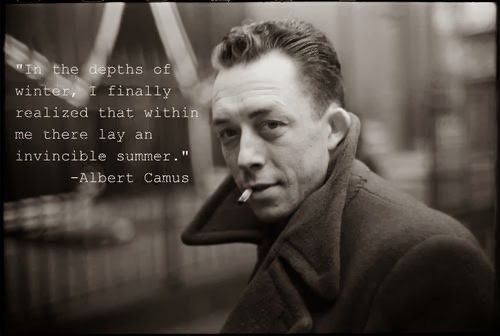
Invincible

from @dailyzen

Tuesday, February 3, 2015

What is Worse Than War?

"War is an ugly thing, but not the ugliest of things. The decayed and degraded state of moral and patriotic feeling which thinks that nothing is worth war is much worse. The person who has nothing for which he is willing to fight, nothing which is more important than his own personal safety, is a miserable creature and has no chance of being free unless made and kept so by the exertions of better men than himself."
--John Stuart Mill (1806-1873)

Tuesday, January 27, 2015

Solitude

John Gohorry, after an oil
painting by Alex Smith
The finished work of a writer is a kind of dialogue with the reader. For the writer this means the creative process is a dialogue with himself, a point neatly made in this poem by John Gohorry


SOLITUDE

Together, they wrote a book.
Its title was Solitude, or
Every Man his own Hermit.
They wrote alternate chapters
in a small room with one chair and a desk
hardly bigger than A4.
Bip wrote on Saturdays, Mondays
and Wednesdays, Bop on the other days.
On Sundays, neither wrote.
On Sundays, they went together
to search for the stuff of fiction.
They travelled, gambled, dug gardens,
dated deep women, whose talk
they would agonise over on weekdays
at that desk, working out meanings.
~John Gohorry

Monday, January 26, 2015

Sixty

Breeze rustling palm fronds,
Open suitcase asking me:
Arrived, or leaving?

Thursday, January 22, 2015

Truly Great Men

(click to ENLARGE)
"This is the status of truly great men:  living, they live for others; dying, they die for others." 

So writes the Maharishi Mahesh Yogi in his commentary on the Bhagavad-Gita. The famous 700-verse Hindu scripture tells the story of the warrior prince Arjuna, who pauses on the brink of a terrible battle to consult with his charioteer and guide, Lord Krishna. Arjuna is filled with self-doubt about his role as a warrior and the righteousness of his cause. His moral dilemma is timeless, as acute today as it was in the 4th and 5th Century BCE, the era in which the Gita was written. As the Maharishi explains:
"A close study of Arjuna's utterances reveals that he is bent upon resisting evil; he is not interested in killing people. He wants to destroy the evil without destroying the evil-doer. It is a noble ideal. His aim is to destroy the evil on earth, if possible without bringing down upon society the untold suffering and destruction of war."
How does one find the courage to act when stopping an evil means commiting an evil? Arjuna's tale was the inspiration for my spiritual adventure thriller, THE ASSASSIN LOTUS, a contemporary take on the daunting challenge of confronting the modern evil of terrorism. 
Click HERE to see more posts.